
This guide is general education, not tax, legal or financial advice. Tax rules, exchange features and bank policies differ by country and change often; check them with your exchange, your bank and a tax professional where you live.
If you hold crypto and want some of it back in your bank account, whether to take profits, pay a bill or rebalance, this guide is for you. By the end you will know the safest route from coins to cash, how to pick a bank that will not freeze the transfer, what to record for tax, and the scams that target people at exactly this moment.
How do you cash out crypto to a bank account?
You cash out crypto by selling it for your local currency on a registered exchange, then withdrawing that money to a bank account in your own name. The sale and the withdrawal are two separate steps, and most problems come from skipping the checks in between.
- Send the coins to the exchange, if they are in your own wallet. Copy the deposit address from the exchange, send a small test first, and check the network matches.
- Sell for your currency. A market order is quick; a limit order lets you set the price. Selling in several slices avoids putting your whole position into one moment's price.
- Withdraw by bank transfer to an account in your own name. Exchanges usually only pay out to an account that matches the verified name on your exchange account.
- Do a small withdrawal first. It shows how long your bank takes and whether it flags the payment, before a large amount is in transit.
- Record the sale. Date, amount, price, fees and what you originally paid. You will need it for tax, and your bank may ask where the money came from.
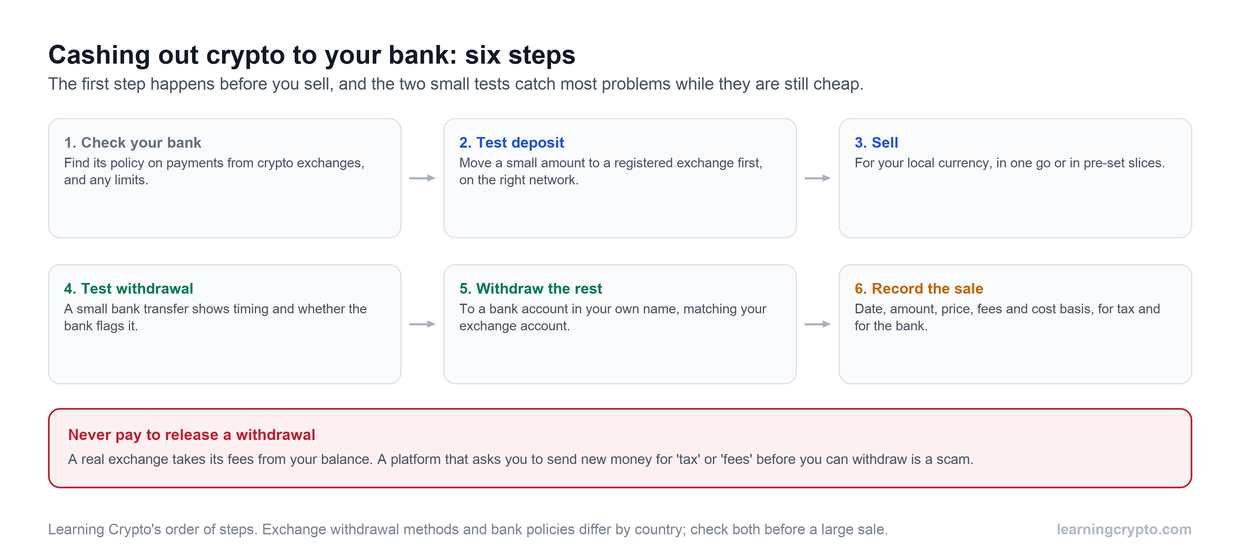
Six steps, and the first one happens before you sell anything. The two small tests are the cheapest insurance in the whole process.
What is the best way to cash out crypto?
For most people the best way to cash out crypto is a registered exchange in your own country, paid out by bank transfer. It is usually the cheapest route, it leaves a clean record for tax and for your bank, and it does not depend on trusting a stranger.
| Route | Good for | Watch out for |
|---|---|---|
| Registered exchange to bank transfer | Most amounts; the default choice | Identity checks, withdrawal limits, and a bank that may question the payment |
| Broker or payments app | Small amounts on an app you already use | Wider spreads, and some apps only pay out to their own balance |
| Peer to peer | Privacy-minded sellers who know the risks | Payment fraud and reversed bank transfers after you have released the coins |
| Crypto debit card | Spending small amounts directly | Each card payment can be a sale for tax, and fees vary widely |
| Bitcoin ATM (selling) | Rarely the right choice | High fees, low limits, and few machines that buy |
Our checklist for checking whether an exchange is safe applies just as much to selling as to buying, and our guide to buying Bitcoin safely covers setting up and securing the exchange account.
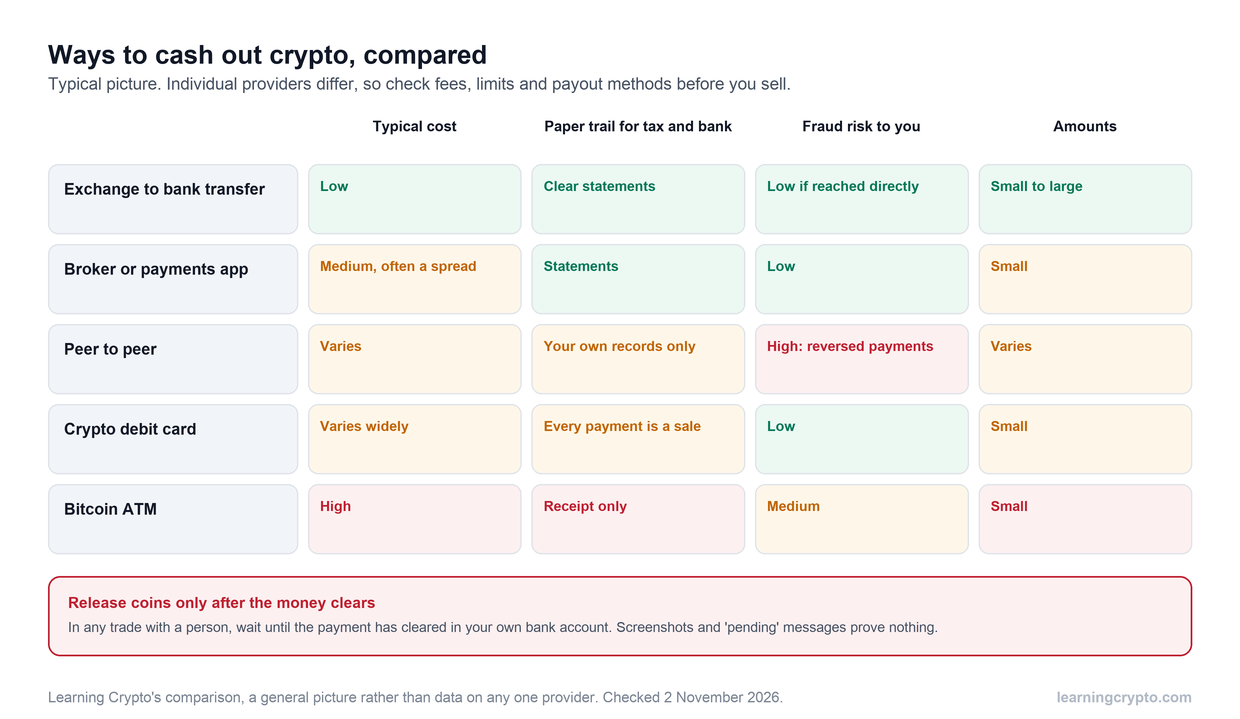
The exchange-to-bank route wins on cost and on the paper trail your bank and tax office will ask for. Peer to peer can work, but it moves the fraud risk onto you.
How do you find a crypto-friendly bank?
You find a crypto-friendly bank by checking three things before you need it: whether the bank publishes a policy on payments to and from crypto exchanges, whether it caps or blocks them, and whether your exchange can pay out to it by your country's normal bank transfer. Banks change these policies, so check the current version rather than relying on a list.
- Search the bank's own help pages for "cryptocurrency" or "crypto exchange". Some banks publish limits on payments to exchanges, or block them for fraud prevention; others say nothing and treat them like any other payment.
- Check the exchange's supported withdrawal methods for your country and currency. A bank that the exchange pays out to directly, by the standard domestic transfer, is the simplest.
- Ask the bank directly before a large transfer: whether incoming payments from a named exchange are accepted, whether there is a limit, and what source-of-funds evidence it wants.
- Keep a separate account for crypto proceeds if your main bank is cautious. It keeps your everyday account out of any review and makes your records cleaner.
- Prepare your evidence before a large withdrawal: exchange statements showing the sale, and records of when and how you bought the crypto. Banks have anti-money-laundering duties, and a clear paper trail is what gets a payment released quickly.
We do not name banks here on purpose. Policies change quietly and differ by country, and a list that was right last month can freeze your money this month. The bank's own help page and a small test withdrawal are the only reliable checks.
Do you pay tax when you cash out crypto?
Usually, yes, in the country where you are tax resident. Selling crypto for money is generally a taxable disposal, and so is swapping one coin for another in many countries. Withdrawing cash you already hold on the exchange is not a second taxable event; the sale is.
- United States. The IRS treats digital assets as property, not currency, and sales are reported on Form 8949. Brokers report sales on the new Form 1099-DA for transactions on or after 1 January 2025, as the IRS explains.
- United Kingdom. Capital Gains Tax applies when you sell, exchange or give away cryptoassets, and gains above the tax-free allowance must be reported, according to HMRC's guidance.
- Elsewhere. Rules vary widely, from no tax on long-held coins in some countries to full income tax in others. Our guide to crypto taxes covers several countries.
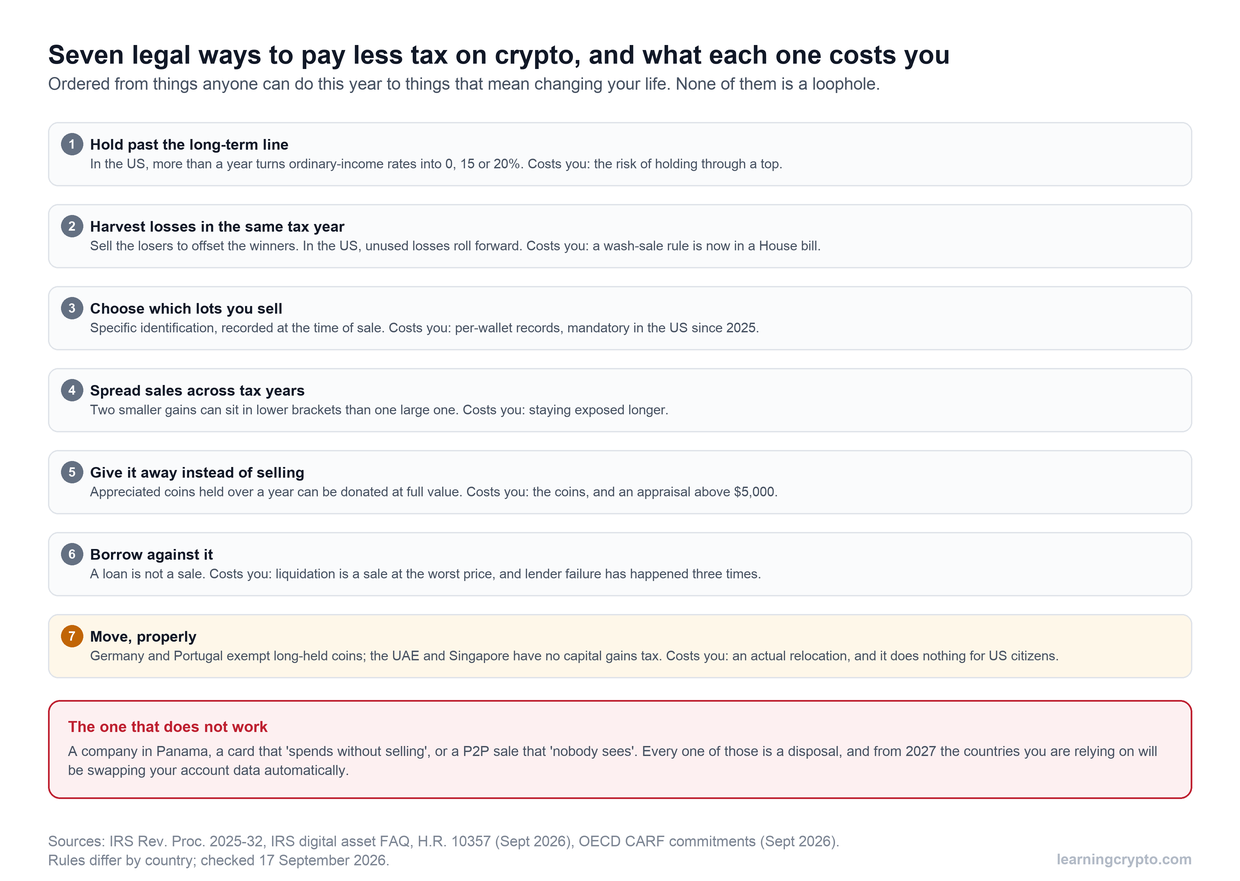
The practical rule is the same everywhere: record every sale as you make it. Our guide to crypto record keeping lists the fields to keep, and legal ways to reduce crypto tax covers timing and loss harvesting before you sell.
How much crypto should you cash out at once?
Most people are better off cashing out in slices rather than in one go. Selling a fixed share at levels you set in advance takes the guessing out of timing, spreads the price you get, and keeps each bank transfer to a size your bank is comfortable with.
A written plan helps more than any indicator: how much you will sell, at what prices, and where the money goes. Our guide to taking profits in crypto sets out the ladder approach, and our portfolio tracker keeps your cost basis and remaining position in one place so the tax maths is ready when you sell.
What scams target people cashing out crypto?
The scams aimed at sellers all try to get your coins before your money arrives, or to get you to pay a fee to release money that does not exist.
- Fake buyers in peer-to-peer trades who send a payment that is later reversed, or a fake payment screenshot, and ask you to release the coins first.
- "Withdrawal fee" and "tax" demands from platforms that show a balance you cannot withdraw. A real exchange deducts its fees from your balance; it never asks you to send new money to release old money.
- Fake support that contacts you when a withdrawal is slow, offering to "speed it up" if you share your login or move funds. Our guide to fake crypto support scams shows the script.
- Recovery offers after a loss, which charge an upfront fee and disappear.
More guides on tax, banking rules and regulation are in the Regulation and Tax hub.
Frequently asked questions
How do I cash out crypto to my bank account?
Sell the crypto for your local currency on a registered exchange, then withdraw the money by bank transfer to an account in your own name. Send a small test deposit and make a small test withdrawal first, so you know the route works and how long your bank takes. Record every sale for tax, and check beforehand that your bank accepts payments from that exchange.
Which banks are crypto-friendly?
It depends on your country and changes often, so check rather than rely on a list. Look for a published policy on payments to and from crypto exchanges in the bank's help pages, confirm your exchange pays out to it by normal bank transfer, and make a small test withdrawal. If your main bank limits exchange payments, a separate account for crypto proceeds keeps things simple.
Do I pay tax when I cash out crypto?
Usually, in the country where you are tax resident. Selling crypto for money is generally a taxable disposal. In the US the IRS treats crypto as property and sales go on Form 8949; in the UK, Capital Gains Tax applies to gains above the annual allowance. Moving cash you already hold from the exchange to your bank is not a second taxable event.
Why did my bank block a transfer from a crypto exchange?
Banks have fraud and anti-money-laundering duties, and some limit or block payments involving crypto exchanges because of scam losses. Call the bank, ask what it needs, and send exchange statements showing the sale and records of how you bought the crypto. If the bank has a standing block on exchanges, a different account for crypto proceeds may be the practical answer.
Is it safe to cash out crypto peer to peer?
It can be, but the fraud risk moves to you. Buyers can send bank payments that are later reversed, or fake payment confirmations, and ask you to release the coins first. Only release coins once the money has cleared in your own bank account, use a platform with escrow and dispute resolution, and treat any pressure to hurry as a warning sign.
How long does it take to cash out crypto?
Selling on an exchange is usually instant. The bank transfer is the slow part: domestic transfers can arrive within hours or take a few business days, depending on your country, your bank and the exchange. A first withdrawal to a new account, or a large one, can take longer if the exchange or the bank runs extra checks, which is why a small test first helps.
Keep learning
- How to Take Profits in Crypto: The Ladder We Use Instead of Guessing the Top
- Crypto Record Keeping: What to Track for Tax
- A Complete Guide to Cryptocurrency Taxes
- How to Buy Bitcoin Safely, Then Move It to Your Own Wallet
- How to Tell If a Crypto Exchange or Wallet Is Safe
- More guides in the Regulation and Tax hub
- Free headlines: the Learning Crypto news feed on Telegram