
AI and crypto are no longer separate stories; they share infrastructure, capital, and risk. AI is running DeFi credit models, executing trades, and securing protocols. It's also draining them. This is the practical state of crypto AI right now, and what it means for anyone holding crypto. |
A lot of coverage still treats AI and crypto as separate beats. One's about smarter machines. The other's about money without banks.
That framing has stopped working.
The biggest DeFi hack of 2026 so far was carried out using AI-assisted social engineering. The fastest-growing stablecoin payment protocol exists specifically so AI agents can pay each other. The largest pure-play AI crypto token doubled in price during a Q1 most assets spent in the red. Pretend these are two industries if you want. The capital flows say otherwise.
What You'll Learn
What's actually shipping. Bittensor subnets, x402 payments, AI security agents, and the projects with real users in 2026.
Where AI is rewriting DeFi. Credit scoring without collateral, agent-managed liquidity, and what intent-based execution means for your wallet.
Why your funds are at higher risk this year. The AI-driven attacks are already costing protocols nine figures, and the defences trying to keep up.
The honest read on AI trading. What bots can do, what they still get wrong, and where the edge actually sits.
The centralization problem nobody on stage wants to discuss. And what decentralized AI is doing about it.
The questions to ask before trusting any of this with your capital.
The Convergence Has Names Now

Bittensor is a production network, not a whitepaper
Bittensor (TAO) runs a $3 billion decentralized machine learning network in which subnets compete to produce useful AI outputs and are paid in tokens
One Bittensor subnet just screened 11 million drug molecules. Another runs a decentralized AI app directory called TaonSquare. The first TAO halving cut daily issuance in half last December. Grayscale reopened its TAO trust to accredited investors this month.
Real revenue underneath it, too: roughly $43 million in quarterly AI-related usage, according to recent estimates.
x402 is the rails AI agents are actually using
Coinbase and Cloudflare built x402 around an HTTP status code from 1997 that nobody used. Now it's the payment layer for AI agents transacting online. As of March 2026 the protocol processed 119 million transactions on Base, 35 million on Solana, and roughly $600 million in annualized volume. Stripe added x402 support in February.
AI agents can now hit paid APIs without accounts, API keys, or human approval. They send stablecoins. They get the data. They move on.
This is what people mean when they say AI and crypto are converging in 2026. Not vibes. Infrastructure.
The structural logic is straightforward
AI has a data problem: most training data is controlled by a handful of companies, and the resulting models inherit their biases and incentives. Blockchain offers something different. On-chain data is auditable, timestamped, and hard to retroactively manipulate. For AI systems making consequential financial decisions, that kind of verifiable history is useful.
Crypto has the inverse problem. Smart contracts execute exactly what they're told and can't tell when something looks wrong. They get exploited in ways their designers never imagined, precisely because they can't pattern-match. AI provides what code alone can't: the ability to learn, adapt, and flag the weird stuff in real time.
Two industries with reciprocal gaps. That's why the convergence is sticking through this market cycle and will stick through the next one.
What AI Is Actually Doing to DeFi Right Now
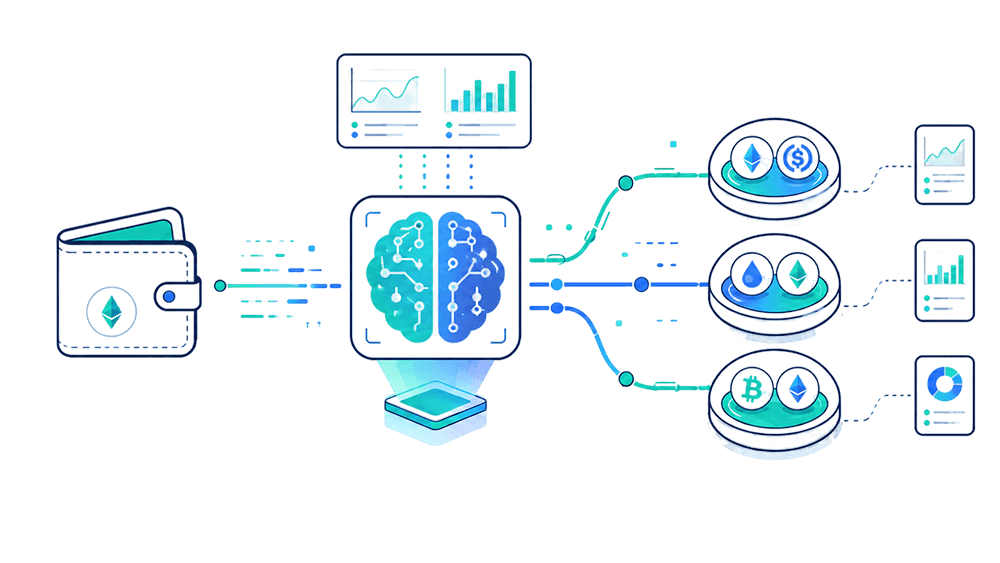
DeFi was always going to need a brain
The first wave was elegant but rigid. Automated market makers with fixed formulas. Lending pools with static collateral ratios. Yield aggregators that could route capital but couldn't anticipate a damn thing. It all worked the way a mechanical clock works. Reliable, narrow, brittle.
Credit scoring without overcollateralization
Traditional DeFi lending requires you to put up 2 ETH to borrow 1 stablecoin. That's not how banks work, and it's a major reason DeFi hasn't eaten retail credit. AI-driven credit models look at on-chain behavior instead: wallet history, transaction patterns, protocol interactions, repayment records.
The technical building blocks now exist to issue under-collateralized loans against an on-chain reputation score. Whether anyone trusts those scores in 2026 is a different question.
Intent-based execution
This one is bigger than the marketing suggests. Instead of you constructing a transaction step by step, you state an outcome ("swap this for that at the best price across any chain") and a solver network competes to execute it. AI agents are increasingly the solvers.
They watch liquidity, gas, MEV opportunities, and slippage. They route. You get the result. The trade-off, as Coincub's analysis of agent architecture made clear earlier this year, is that you've handed execution to opaque off-chain optimization. Efficiency up. Visibility down.
Session keys via EIP-7702
Ethereum's EIP-7702 lets users grant scoped, temporary permissions to AI agents without handing over the full private key. An agent can rebalance a portfolio for 24 hours, within a defined spending limit, then lose access. This is what makes it practical to deploy autonomous agents that hold and move real funds without giving them the keys to the kingdom.
Agent-managed liquidity
AI agents now monitor pool positions, respond to impermanent loss, and rebalance faster than any human strategy. Some are running 24/7 across global exchanges. They're not magic. But for liquidity provision, where the work is mostly vigilance and speed, they're a meaningful upgrade.
Agents with their own economies
Virtuals Protocol launched its Agent Commerce Protocol (ACP) in March 2026, with live integrations on Arbitrum and Base. Each agent mints its own token, earns revenue through inference calls on social platforms, games, and DeFi apps, and trades against the VIRTUAL token in liquidity pools.
The agent is the economic unit. You're not paying a developer to access an AI service. You're holding equity in the agent itself. Whether this scales beyond niche use cases is an open question.
The Security Picture Got Worse Before It Got Better
April 2026 was the worst month for DeFi exploits since the 2022 bridge collapses.
The numbers tell the story
Kelp DAO lost $293 million on April 19, the largest DeFi hack of the year. Drift Protocol lost $285 million on April 1. By mid-April, total DeFi losses for 2026 had topped $750 million. Bridge infrastructure took most of the damage, as it usually does.
What's new is how the attacks are being run.
AI is doing the attacking now
The Drift exploit was executed by North Korean-affiliated hackers who spent six months socially engineering their way in, using AI-generated content to maintain the deception. GoPlus Security flagged four separate AI-assisted smart contract exploits in a 48-hour window ending April 29. They called the current pace a "countdown-by-the-second era."
The research backs it up. a16z crypto tested an off-the-shelf AI coding agent against 20 historical price manipulation incidents on Ethereum. With minimal tools, the agent succeeded 10% of the time. Give it structured knowledge about common attack patterns, and the success rate climbed dramatically.
Separate research from Anthropic and OpenAI shows AI agents can execute end-to-end smart contract exploits at an average cost of about $1.22 per contract. Exploit capability is reportedly doubling every 1.3 months.
The barrier to mass-scale vulnerability scanning is now somewhere around the price of a coffee.
Defenders have AI too. They're just slower to deploy it
Cecuro, an AI security firm, published a benchmark in February showing that a purpose-built AI security agent detected vulnerabilities in 92% of 90 exploited DeFi contracts. A generic GPT-5.1 coding agent on the same model only caught 34%.
The capability is there. Most teams haven't deployed it yet. Several of the exploited contracts in the dataset had been through professional human audits before they got drained.
So the honest read on AI and crypto security in 2026 is this: AI is making both offense and defense more capable, the offense is currently winning on adoption speed, and the gap between teams using AI for security and teams not using it is becoming the gap between solvency and insolvency.
If you're holding meaningful capital in DeFi, ask which protocols run continuous AI monitoring and which still rely on a single audit from 12 months ago.
AI Trading: What's Real and What Isn't
The intelligence layer got an upgrade
Algorithmic trading in crypto isn't new. Bots have been running arbitrage and market-making for a decade. What's changed is the layer of intelligence sitting behind execution.
Rule-based systems followed thresholds. Modern AI-driven systems identify patterns across multiple data streams, adjust parameters as conditions shift, and process signals that older systems couldn't touch.
Sentiment analysis is one of the more useful applications. Crypto markets respond to narrative faster than to fundamentals. A single post from an influential account can move prices in ways no chart-based model predicts. AI systems trained on social media, news feeds, on-chain metrics, and forum activity can generate real-time sentiment signals that sometimes correlate with short-term price movements.
Sometimes is the operative word.
Here's what AI trading does well, and doesn't
What it does well: process more sources faster than any analyst, maintain consistent discipline across global hours, rebalance risk exposure on rules you actually wrote down, flag concentration risk before it bites.
What it still doesn't do: reliably predict crypto markets. Nobody does. AI systems get murdered by genuinely novel conditions because their advantage is pattern recognition, and a black swan is the absence of a pattern.
The April flash crashes, the Drift exploit, sudden macro shocks like the Iran-related oil spike that hit risk assets on April 29: these are exactly the conditions where AI trading underperforms a human who knows when to do nothing.
Crypto Got Decentralized. AI Didn't.
Crypto exists to distribute power. No single party controls the ledger, sets the rules, or freezes your funds. That's the whole point.
AI development looks nothing like that. A handful of large organizations control the most capable models, the compute they run on, and the data they train on.
If the DeFi protocols are quietly dependent on AI models built and controlled by three or four companies, then the decentralization crypto provides at the infrastructure layer is being undermined at the intelligence layer.
This isn't hypothetical. It's already happening
Many "AI-powered" DeFi features in production are calling out to OpenAI, Anthropic, or Google APIs. The protocol is on-chain. The brain isn't. If those API providers change their terms, restrict access, or get told to filter certain categories of requests, the dependent protocols inherit those restrictions. The whole stack becomes only as decentralized as its most centralized dependency.
The response is decentralized AI infrastructure
Bittensor is the most visible attempt. Render and Akash provide decentralized GPU compute. The ASI Alliance (Fetch, SingularityNET, Ocean) is consolidating autonomous agent infrastructure under one umbrella.
Venice (VVV) takes a different angle, offering private, uncensored AI inference where you stake the token to get API access instead of paying per request. These projects have real users and real revenue. They're also not at frontier-model capability.
The bet is that the gap closes. The risk is that it doesn't, or that it closes too slowly, and by the time decentralized AI catches up to centralized AI, the dependent DeFi protocols have already standardized on the centralized version. Worth watching.
Privacy, Bias, and Regulation
A few more things that belong in any honest accounting.
Privacy is structurally compromised
Blockchain's transparency is its trust mechanism and its privacy problem. Once AI systems can draw inferences from transaction patterns at scale, the pseudonymity most users rely on is thinner than it looks. Zero-knowledge proofs offer partial solutions, and they're improving fast. Their integration with AI inference is still in its early stages.
Bias is being automated, not fixed
AI models trained on historical financial data learn the patterns in that data, including which communities were excluded from financial services and which wallets got flagged disproportionately by existing compliance tools. If AI-driven credit decisions in DeFi reproduce those patterns at scale and at speed, the technology that was supposed to bank the unbanked ends up automating their exclusion. This is not a future problem.
Regulation hasn't caught up
Most jurisdictions still don't have settled frameworks for crypto. Adding AI decision-making creates a second set of unanswered questions. Who's liable when an AI-driven lending protocol makes a discriminatory credit decision? How should an AI trading agent be classified under securities law? The answers currently don't exist.
We're Not Anti-AI. We're Pro-Doing It Properly.
This piece has spent a lot of time on the hard parts. The hacks, the centralization risk, the bias, the gap between what's promised and what works. That's deliberate. Most coverage of crypto AI is selling something.
But we're not waving it off. We're using it.
Learning Crypto runs its own AI copilot alongside live on-chain analytics, smart money tracking, and a Classroom community where people figure this out together. The copilot pulls verifiable data instead of making things up. The analytics show you what wallets are actually doing, not what Twitter says they're doing.
The Classroom is where you go to test your thinking against people who've been in this longer than the current cycle.
We think the convergence of AI and crypto is one of the most important shifts in this market. We also think most people will get it wrong because they're listening to the people selling tokens instead of the people using the tools.
Get Started with the Right Tools
FAQs
What is Crypto AI?
Crypto AI is the practical integration of AI systems with blockchain networks, DeFi protocols, and crypto markets. In 2026, it means decentralized AI networks like Bittensor, AI-driven security and credit models, AI agents that hold wallets and execute on-chain transactions, and payment protocols like x402 that let agents transact in stablecoins without human intervention.
How is AI being used in DeFi right now?
Real applications include on-chain credit scoring for under-collateralized lending, AI-managed liquidity provision, intent-based execution where AI agents act as solvers, continuous AI monitoring for smart contract exploits, and AI copilots that translate on-chain activity into plain language. Several protocols have live implementations. Quality varies.
Are AI-generated tokens and AI agent coins worth holding?
Depends what you're buying. Infrastructure plays like Bittensor, Render, and Akash have real revenue, real users, and a clear product. Agent tokens like Virtuals are more speculative, but at least tied to an actual platform doing actual things. AI memecoins with anime mascots and no working product are gambling. Treat the categories as distinct assets with distinct risk profiles, not as a single bucket labeled "AI crypto." A lot of new tokens are using the AI label to ride the narrative.
Sources & Further Reading
Anthropic — AI agents find $4.6M in blockchain smart contract exploits. SCONE-bench research on AI exploit economics. red.anthropic.com/2025/smart-contracts
a16z crypto — Can AI agents actually pull off DeFi exploits? Benchmark testing AI agents against 20 historical Ethereum exploits. a16zcrypto.com
CoinDesk — Specialized AI detects 92% of real-world DeFi exploits. Cecuro benchmark on AI security agents, February 2026. coindesk.com
Coinbase Developer Platform — official x402 protocol documentation. docs.cdp.coinbase.com/x402
CoinMarketCap — Bittensor (TAO) latest updates: halving, Grayscale Trust, subnet milestones. coinmarketcap.com
TheStreet Crypto — Major DeFi hack becomes the largest of 2026 yet. Kelp DAO and Drift Protocol exploit coverage. thestreet.com/crypto
CoinMarketCap — Venice Token (VVV) overview, tokenomics, and platform data. coinmarketcap.com