
Information in this article is current as of February 2026. Hardware specs, pool fees, and network conditions change frequently. Always verify with a profitability calculator before committing resources.
Bitcoin mining stopped being a hobby years ago. If you don't have a warehouse full of ASICs and a sweetheart deal on electricity, you're not competing. Monero took a different path.
Its RandomX algorithm was specifically built to run efficiently on everyday CPUs, the same hardware sitting inside your desktop right now. That design choice keeps mining distributed across thousands of home computers instead of concentrated in a handful of industrial facilities.
It also means you can start mining without spending thousands on specialized equipment.
That said, Monero mining won't make you rich. With current XMR prices and network difficulty, most CPU miners earn modest supplemental income.
We’ll share the honest numbers on what you can actually expect to earn, as well as everything from picking hardware to collecting your first payout.
Mining Monero Quick Takeaways
→ RandomX favors CPUs. You can mine XMR with the processor already in your PC. No GPU or ASIC required.
→ XMRig is the standard. Free, open-source, runs on Windows, Linux, and macOS.
→ Electricity cost decides everything. Below ~$0.08/kWh, CPU mining turns a small profit. Above that, margins disappear.
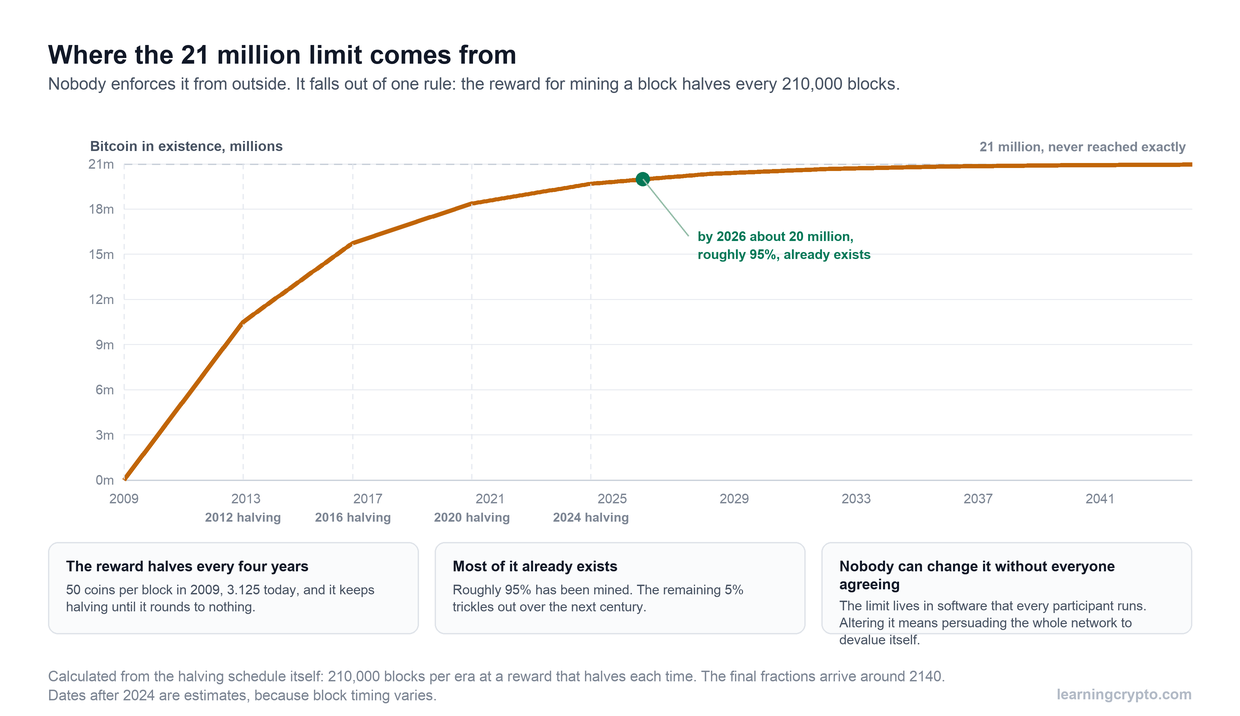
→ Tail emission means permanent rewards. Block rewards stay at 0.6 XMR (~every 2 minutes) forever. No halvings.
What Makes Monero Mining Different
Privacy-First Cryptocurrency
Monero exists to make transactions private. Every XMR transfer uses ring signatures to mix your transaction with others, stealth addresses to generate one-time destinations, and RingCT to hide amounts. Mining secures this privacy network by validating transactions and adding new blocks to the chain.
RandomX Algorithm
RandomX is a proof-of-work algorithm optimized for general-purpose CPUs. It requires 2 GB of RAM per mining thread, executes random code that mimics real CPU workloads, and uses instruction sets that commodity processors already handle well.
The result is that your desktop CPU performs nearly as efficiently per watt as purpose-built hardware.
This is the opposite of Bitcoin, where mining rigs costing tens of thousands of dollars leave home miners with zero chance.
Decentralization vs. Bitcoin Mining
Bitcoin mining is dominated by industrial ASIC farms in regions with cheap power. Monero's hashrate is spread across thousands of individual machines worldwide. That distribution is deliberate and reflects the project's core philosophy: no single entity should control transaction validation.
Tail Emission
Unlike Bitcoin (which halves its block reward every four years until it reaches zero), Monero introduced a tail emission in May 2022. Every block now pays exactly 0.6 XMR, and that rate continues indefinitely.
New blocks arrive roughly every two minutes, producing about 432 XMR per day across the entire network. This guarantees miners always have a financial reason to keep the network secure.
Hardware Options for Mining Monero
CPU Mining
AMD Ryzen processors dominate Monero mining because of their large L3 caches and strong memory bandwidth. If you're new to crypto mining, a CPU you already own is the easiest place to start.
CPU | Approx. Hashrate | Power Draw |
AMD Ryzen 9 9950X | ~27 kH/s | ~170W |
AMD Ryzen 9 7950X | ~22 kH/s | ~230W |
AMD Ryzen 5 5600X | ~7 kH/s | ~80W |
AMD EPYC 9754 (server) | ~55–80 kH/s | ~360W |
Hashrates are approximate and vary with cooling, RAM speed, and configuration. Verify with XMRig benchmarks for your specific hardware.
What matters most: L3 cache size, core count, RAM speed (DDR5 helps), and adequate cooling. AMD consistently outperforms Intel on RandomX because of cache architecture differences.
ASIC Mining: The Antminer X9
Bitmain's Antminer X9 is the first production-grade RandomX ASIC, with batch shipments scheduled for July 2026. It uses custom RISC-V cores optimized specifically for RandomX workloads, delivering 1 MH/s (1,000 kH/s) at 2,472W with an efficiency of 2.47 J/kH. That's roughly 45x the hashrate of a top consumer CPU in a single unit. The price sits around $5,600.
This is industrial hardware. It runs at ~75 dB (louder than a vacuum cleaner), needs a 220V–277V power supply, and generates enough heat to require dedicated ventilation. Most retailers and hosting providers don't recommend it for residential use.
Miners with access to hosted facilities at low electricity rates will see the strongest returns, with some providers advertising ROI in the 6–9 month range, depending on the XMR price and difficulty at the time of deployment.
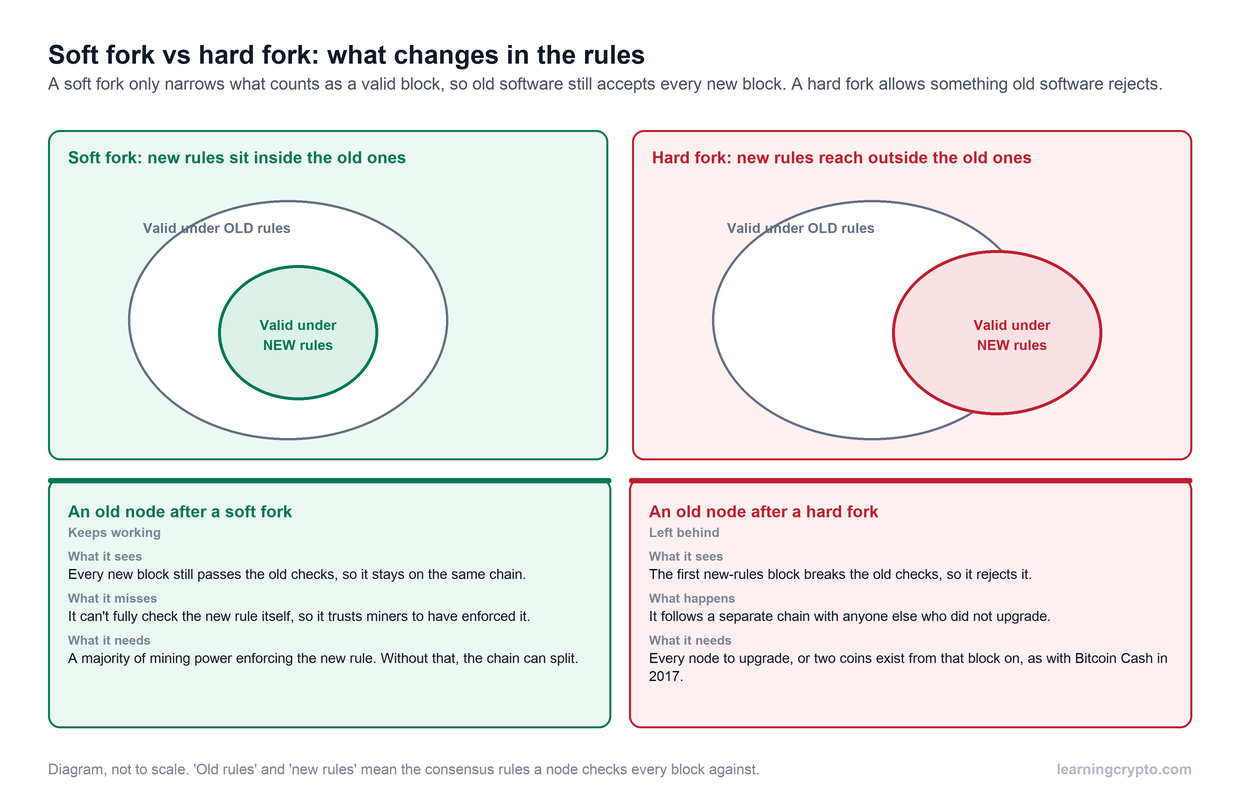
The Monero community has historically forked the algorithm to fight ASIC centralization. Whether the community responds to the X9 with another protocol change is an open question, and possibly the biggest risk for anyone considering this investment.
If Monero hard forks to a new algorithm, your ASIC could become an expensive paperweight.
GPU Mining
Not recommended. RandomX was designed to penalize GPUs, and they produce worse hashrate-per-watt than CPUs on this algorithm.
Which Setup Should You Choose?
CPU mining makes sense if you're supporting network decentralization, have moderate electricity costs, or want to learn how mining works without a large upfront investment.
ASIC mining makes sense if you have access to cheap industrial power, plan to mine at a commercial scale, and are comfortable with the risk that Monero's community could change the algorithm.
Monero Mining Software and Tools
XMRig
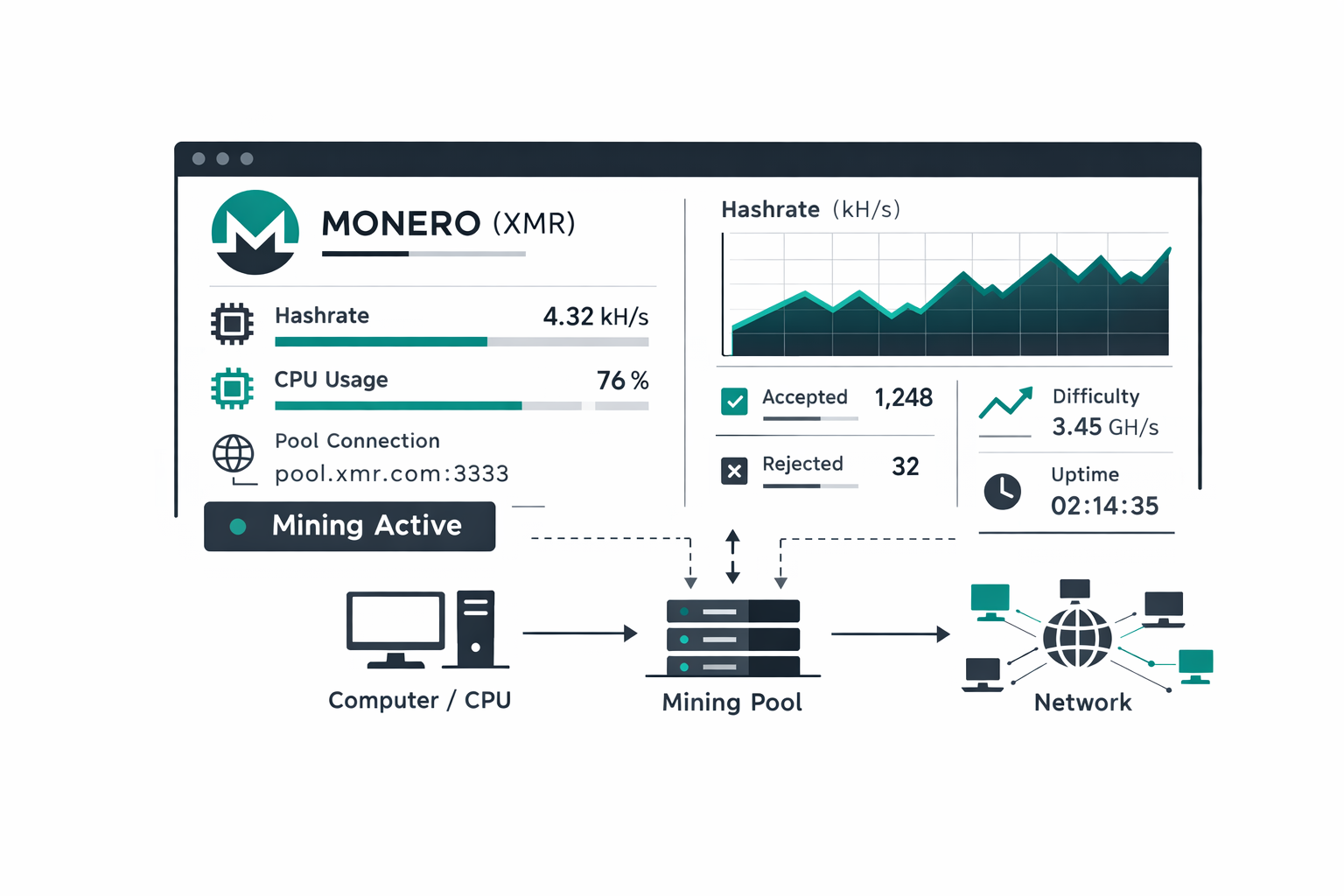
XMRig is the open-source standard for Monero mining. It runs on Windows, Linux, and macOS, supports CPU and GPU mining, and includes built-in optimizations for RandomX. Download it directly from the official GitHub repository.
Be aware that antivirus software often flags mining programs because the same tools get used in malware. If you downloaded from the official source, it's safe to whitelist.
P2Pool
P2Pool is a decentralized mining pool with no central operator. Your mining rewards come directly from the blockchain, not from a pool administrator. There are no fees. The trade-off: you need to run a full Monero node alongside your miner, which requires 100+ GB of storage and more technical setup.
Traditional Pools
If you want the simplest experience, traditional pools handle the infrastructure:
Pool | Fee | Payout Model | Notes |
SupportXMR | 0.6% | PPLNS | Long-running, stable, large hashrate share |
MoneroOcean | 0% | PPLNS | Auto-switches to the most profitable algo, pays in XMR |
C3Pool | 0% | PPLNS | Good for low-hashrate miners |
Pool fees and features change. Verify current terms on each pool's website before connecting.
Solo vs. Pool vs. P2Pool
Solo mining gives you the full 0.6 XMR block reward when you find a block, but at typical home hashrates, that could take months or years. Only practical with massive hashrate.
Traditional pools split rewards proportionally among all contributors. Consistent payouts, minimal setup, but you're trusting the pool operator.
P2Pool gives you pool-style consistent payouts without a central operator. The Monero community actively recommends P2Pool because it supports network decentralization.
How to Mine Monero Step by Step
Step 1: Set Up a Wallet
You need a Monero wallet address to receive mining rewards. Options include the official Monero GUI Wallet (desktop), Cake Wallet (mobile), or a hardware wallet like Trezor or Ledger.
If you don't already hold XMR, you may want to buy Monero first to familiarize yourself with the ecosystem. For privacy, use a subaddress specifically for mining.
Step 2: Choose Your Approach
Pool mining is the easiest path for most people. P2Pool is better for decentralization, but requires running a full node. Solo mining is not recommended unless you have an exceptionally high hashrate.
Step 3: Join a Mining Pool
Pick a pool from the table above. Note the pool's connection URL and port. Most Monero pools don't require registration. You connect with your wallet address as your username.
Step 4: Download XMRig
Go to the official XMRig GitHub releases page. Download the binary for your operating system. Extract it to a folder you'll remember. Add the folder to your antivirus whitelist before running.
Step 5: Configure XMRig
Open config.json in a text editor and set:
1. Pool URL and port: e.g., pool.supportxmr.com:443
2. Your wallet address: paste your Monero receiving address
3. Enable huge pages: this alone can boost hashrate by 10–30%
4. Thread count: match your CPU core count (leave 1–2 cores free if you use the PC for other tasks)
5. TLS: enable if your pool supports it for encrypted connections
To make it even easier, XMRig also has a configuration wizard at xmrig.com that generates the config file for you.
Step 6: Start Mining
Launch XMRig (run as administrator on Windows for huge pages access). You should see accepted shares appearing in the console within minutes. Let it run for 24 hours to establish a stable hashrate baseline.
Step 7: Optimize and Monitor
Check your pool's dashboard by entering your wallet address on their website. Monitor CPU temperatures (keep below 85°C). If hashrate seems low, confirm huge pages are active, and that background processes aren't competing for CPU resources.
Common Issues
Antivirus blocks XMRig: Whitelist the folder. This is expected behavior.
Low hashrate: Enable huge pages, close background apps, and check cooling.
No accepted shares: Verify pool URL, port, and wallet address in config.json.
High temperatures: Reduce thread count or improve case airflow.
Is Mining Monero Profitable?
Calculating Earnings
Mining income depends on six variables: your hashrate, power consumption, electricity rate, pool fees, XMR market price, and network difficulty. Of these, electricity cost is the one you control, and it's typically the difference between profit and loss. Use a calculator like CoinWarz or Minerstat with your actual specs before committing.
Electricity Cost Is Everything
Below ~$0.06/kWh: Solid margins.
$0.06–0.10/kWh: CPU mining breaks even or earns modestly.
Above $0.10/kWh: CPU mining is likely to run at a loss.
Other Factors
XMR price volatility can turn a profitable operation negative overnight (or the reverse). Network difficulty adjusts frequently based on the total hashrate. Hardware degrades over time. Pool fees, while small, add up. Factor all of this in before treating mining income as reliable.
Risks and Future Outlook of Mining Monero
Risks
Financial: XMR price drops, electricity rate increases, or difficulty spikes can erase margins.
Technical: CPU mining generates heat and accelerates hardware wear. Complex setup can frustrate beginners.
Centralization: If ASICs capture a large share of hashrate, the network becomes less distributed, undermining Monero's core value proposition.
Regulatory: Privacy coins face increasing scrutiny from regulators. Several exchanges have delisted XMR in certain jurisdictions, which can affect liquidity and price.
Network Upgrades
The Monero development community is actively working on FCMP++ (Full-Chain Membership Proofs), which would replace ring signatures with a system where every transaction hides among nearly all outputs on the blockchain.
Seraphis and Jamtis, a new transaction protocol and address format, are in testing and would represent the biggest protocol change since RingCT.
Neither upgrade is expected to change mining hardware requirements, so current equipment should remain compatible.
Where to Go From Here
Monero mining remains one of the few proof-of-work opportunities where a regular computer can contribute meaningfully.
RandomX keeps the barrier to entry low, tail emission guarantees rewards won't dry up, and the privacy features you're helping secure have real demand.
Start with what you have. Run XMRig for a week, check the numbers, and decide whether the power bill makes sense for your situation.
Ready to build on what you've learned?
Learning Crypto combines AI-powered on-chain analytics with education built by people who've lived through multiple market cycles. Track what smart money is doing, verify data yourself, and build crypto knowledge that holds up when markets move.
FAQs
Can I mine Monero with my regular computer?
Yes. Monero's RandomX algorithm was built for consumer CPUs. Any modern multi-core processor can mine XMR. AMD Ryzen chips with large L3 caches perform best, but Intel CPUs work too. You won't get rich, but you'll earn XMR proportional to your hashrate.
Is Monero mining still profitable?
It depends entirely on your electricity cost. If you're paying under ~$0.08/kWh, a mid-range to high-end CPU can turn a small profit. Above that threshold, the power bill often exceeds what you mine. Check a profitability calculator with your actual hardware specs and power rate before starting.
What's the difference between CPU and ASIC mining for Monero?
CPU mining uses the processor in your everyday computer. It's accessible, quiet enough for home use, and supports network decentralization. ASIC mining uses specialized hardware that delivers a vastly higher hashrate but costs thousands of dollars, runs loud, and draws industrial power. ASICs are more profitable per unit but raise centralization concerns.
Do I need to run mining 24/7?
No, but your earnings scale directly with uptime. Mining for 8 hours earns one-third of what a 24-hour operation produces. Most CPU miners run their rigs overnight or when the computer is otherwise idle.
What is P2Pool and should I use it?
P2Pool is a decentralized mining pool without a central operator. It combines the consistent payouts of pool mining with the trust model of solo mining. You need to run a full Monero node (100+ GB storage), which makes setup more involved. The Monero community recommends P2Pool because it directly supports network decentralization.
Useful Resources
Monero Official Site – Project documentation, wallet downloads, and mining guides from the Monero team.
XMRig GitHub Releases – Official download page for XMRig mining software.
P2Pool – Setup instructions and stats for decentralized Monero pool mining.
CoinWarz Monero Calculator – Profitability calculator using live network difficulty and XMR price.
MiningPoolStats – Live hashrate distribution and fee comparison across Monero mining pools.
Keep learning
- Most Profitable Cryptocurrencies to Mine in 2026
- Staking vs Mining: What’s the Difference, and Which Is Better for You?
- What Happens When All The Bitcoin Is Mined?
- More guides in the Bitcoin hub
- Members: Satoshi Indicator, a daily Bitcoin DCA signal for members