
Crypto referral programs are everywhere, and the headline numbers are rarely what anyone actually earns. This guide compares the programs worth your time in 2026, with every figure checked against each platform's own terms in September 2026, and separates the two very different kinds: bonuses for inviting friends, and commissions for people with an audience. By the end you will know what each program pays, how much is realistic, and which rules cost people their rewards.
Disclosure: Learning Crypto runs its own partner program, which is included and explained in full below. We describe it the same way we describe every other program, with its terms and its limits. Nothing here is financial advice, and referral rewards can be taxable.
What is a crypto referral program?
A crypto referral program rewards you when someone joins a platform through your personal link or code and does something that platform values, usually depositing money, trading, or paying for a subscription. The reward is either a fixed bonus, often in crypto, or a percentage of the fees or subscriptions your referral pays.
The term covers two different arrangements, and mixing them up is the most common reason people end up disappointed.
| Referral program | Affiliate or partner program | |
|---|---|---|
| Who it is for | Any customer with a few friends to invite | People with an audience: a newsletter, channel, community or website |
| How you join | Automatic; the link is in your account | An application, sometimes with approval |
| What it pays | A small bonus per friend, sometimes a share of their fees for a limited period | A percentage of sales or fees, often recurring |
| Typical example | Kraken paying both of you a random $5 to $50 | Learning Crypto paying 20% of every renewal |
| Who earns real money | Almost nobody, beyond the first few friends | People whose audience trusts their recommendations |
If you have a handful of friends who are about to open an account anyway, a referral link is free money for both of you. If you teach, write or post about crypto, the affiliate side is where the numbers change.
How to earn crypto with referral links
You earn crypto with referral links by sharing a personal link from a platform you already use, getting people to sign up through it, and making sure they complete the qualifying action before the deadline. The steps are the same almost everywhere.
- Use the platform yourself first. Referral links only convert when you can answer questions about the product, and recommending something you have not used is how people end up promoting a platform that later fails.
- Find your link. Exchanges put it under a referral or invite section in the app. Affiliate programs give you a link and a dashboard after you apply.
- Read the qualifying rules. Most rewards need a deposit or trade within a set number of days, and a few require the friend to live in your country.
- Share it where people are already asking. A link in an answer to a specific question converts far better than a link posted into a group with no context.
- Say it is a referral link. Advertising rules in most countries require it, and it keeps people's trust.
- Track what paid. Dashboards show clicks, sign-ups and rewards. Keep a record for tax, as covered below.
The best crypto referral programs in 2026 at a glance
Terms below were checked against each platform's own pages in September 2026. Programs change their rewards often and vary them by country, so treat the table as a map and your own account as the final word.
| Program | Type | What you earn | Key condition |
|---|---|---|---|
| Learning Crypto | Partner program | 40% of a new member's first payment, up to $280, then 20% of every renewal | The member subscribes through your link |
| Coinbase | Referral | A crypto or cash bonus that varies by country | Friend makes a qualifying purchase within 90 days |
| Kraken | Referral | A random reward of $5 to $50 for both of you | Friend deposits fiat within 15 days; same country |
| Binance | Referral, two tiers | Up to $1,000 in fee vouchers, or up to 50% commission on the Pro tier | Friend buys at least $50 and trades at least $100 |
| Bybit | Referral | 20% to 30% of your friends' trading fees for a year, plus task bonuses | Friend deposits 100 USDT in 7 days and trades 500 USDT in 30 |
| Crypto.com Exchange | Referral | 50% of your friend's net trading fees for 12 months | Friend locks at least 1,000 CRO; not in the UK or EEA |
| Hyperliquid | Referral | 10% of your referrals' trading fees | You need $10,000 of your own trading volume to create a code |
| Trezor | Affiliate | Up to 15% of each sale | 30-day cookie window |
| Ledger | Affiliate | A percentage of each sale; around 10% according to affiliate directories | Application through Ledger's affiliate site |
| Koinly | Affiliate | 20% commission | Join from inside a Koinly account |
| CoinLedger | Affiliate | 25% recurring, every year the customer renews | Application; payouts every 30 days |
The Learning Crypto partner program
Our own program is built for people who already talk about crypto to an audience that wants to understand it rather than chase it. You earn 40% of a new member's first payment, capped at $280, and then 20% of every renewal for as long as that member stays subscribed. There is no cap on how many members you can refer, and it runs through a dedicated affiliate dashboard where every click, sign-up and commission is recorded.
It is the only program on this list that pays you for recommending education rather than a trading account, which changes who it suits. You are not asking your audience to deposit money into an exchange. You are recommending daily analysis, the Ask Crypto research assistant, portfolio tools and, on the higher plan, the Satoshi Indicator. That is an easier recommendation to make honestly, and the people it converts tend to stay, because they joined to learn.
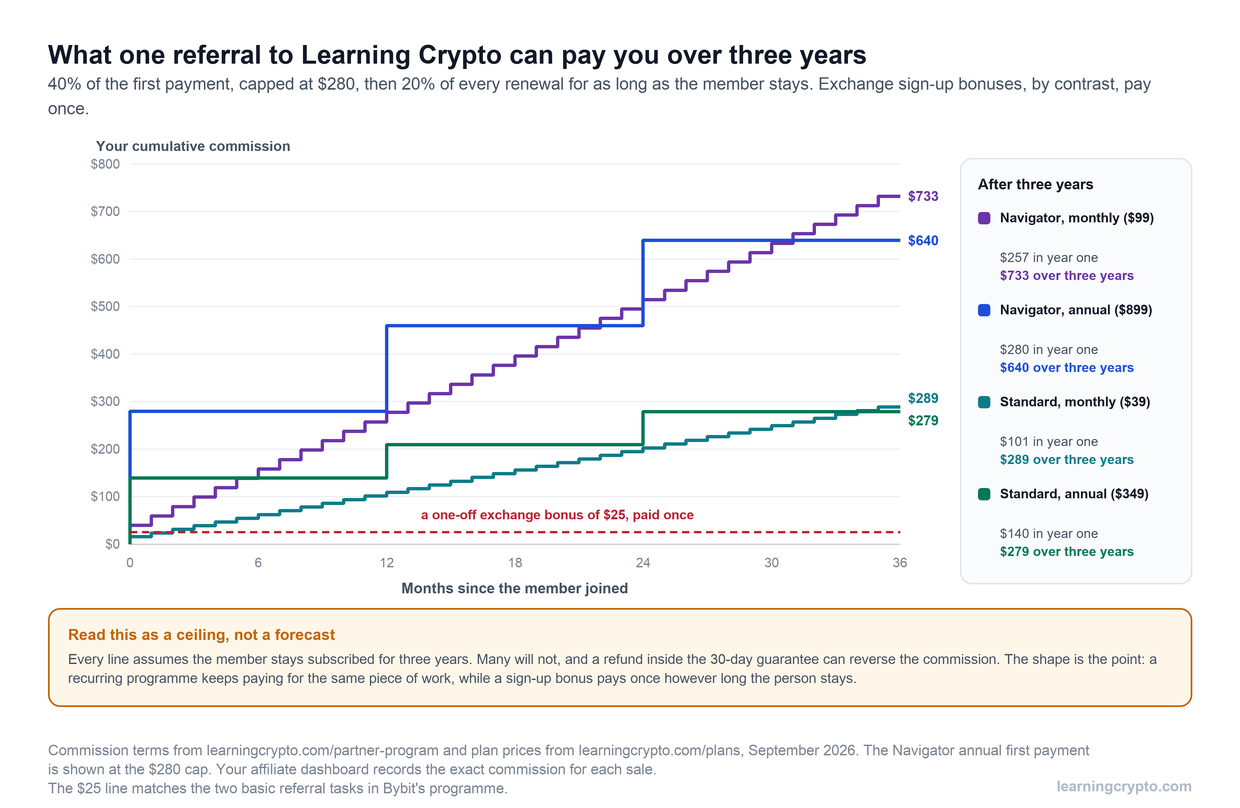
The same piece of work, paid two ways. A recurring commission keeps paying for as long as the member stays; a sign-up bonus pays once. The lines are a ceiling, because not every member stays for three years.
Here is what one member is worth to you at current prices, if they stay subscribed:
| The member's plan | First commission | Each renewal after that | Year one | Three years |
|---|---|---|---|---|
| Standard, $39 a month | $15.60 | $7.80 a month | $101 | $289 |
| Standard, $349 a year | $139.60 | $69.80 a year | $140 | $279 |
| Navigator, $99 a month | $39.60 | $19.80 a month | $257 | $733 |
| Navigator, $899 a year | $280, the cap | $179.80 a year | $280 | $640 |
Put plainly, twenty members who stay on Navigator are worth several thousand dollars a year to the person who referred them, and it keeps arriving without new work. The honest limits: those figures assume members stay, plan prices come from our plans page and can change, and a refund under the 30-day money-back guarantee can reverse the commission on that sale. The program terms and your dashboard are the record of what each sale paid.
Who it suits: newsletter writers, YouTube and podcast hosts, community organisers, financial educators and anyone whose audience is over 40, serious about their money and wary of hype. Who it does not suit: people looking to spam links into trading groups. The program pays for trust, and trust does not survive that. To join, apply on the partner program page; you get your link and dashboard straight away.
Referral programs from exchanges
These pay small amounts per friend and are easy to earn. They suit anyone who is going to recommend an exchange to a friend anyway.
Coinbase
Coinbase pays both you and your friend a bonus once your friend completes a minimum qualifying purchase by bank transfer, debit card or credit card, within 90 days of their account becoming able to trade. The amount varies by country and is shown on the referrals page in your account, per Coinbase's help centre. It is the simplest program here and the one most beginners will actually use. For a view of the platform itself, see our Coinbase and Kraken comparison.
Kraken
Kraken's referral program pays both of you a random reward between $5 and $50, with most rewards between $5 and $20. Your friend must sign up through the mobile app, deposit fiat rather than only stablecoins, and complete the steps within 15 days, and generally live in your country. Rewards arrive after at least 14 days. Kraken explicitly bans promoting the link with paid search or sponsored posts. Our review of whether Kraken is safe covers the exchange.
Binance
Binance runs two tiers. Referral Lite pays the referrer up to $1,000 in trading fee rebate vouchers, and the friend up to $1,100, after the friend buys at least $50 of crypto and trades at least $100. Referral Pro pays up to 50% commission on friends' trading. Binance is not available to US residents, and the vouchers are fee credits rather than cash, which matters when comparing it with others. Our Coinbase and Binance comparison covers where it operates.
Bybit
Bybit pays referrers 20% of their friends' trading fees for 365 days, rising to 25% after five qualified friends in a quarter and 30% at 100, according to Bybit's referral FAQ. A qualified friend deposits at least 100 USDT within 7 days and trades at least 500 USDT within 30. Each completed task pays both of you a bonus, 10 USDT for the deposit and 15 USDT for the trade, and bigger task rewards push the headline to 1,720 USDT. A friend who forgets your code cannot be added later.
Crypto.com Exchange
The Crypto.com Exchange program pays 50% of your friend's net trading fees for 12 months, plus a bonus of up to $2,000 in CRO that depends on how much CRO your friend locks. The friend must complete advanced verification and lock at least 1,000 CRO. It is not available in the UK, Hong Kong or the EEA, and it is separate from the Crypto.com app's own program.
Hyperliquid
Hyperliquid pays referrers 10% of their referrals' trading fees for their first $1 billion of volume, and gives referred traders a 4% fee discount on their first $25 million, per its documentation. You need $10,000 of your own trading volume before you can create a code. It suits people whose audience already trades perpetual futures; our guide to what Hyperliquid is explains the platform and its risks.
Affiliate programs for creators and educators
These require an application and pay a percentage of what your audience buys. They reward trust more than reach.
Trezor and Ledger
Trezor's affiliate program pays up to 15% of each order's net value, excluding VAT and shipping, with a 30-day cookie and monthly payouts in euros or Bitcoin. Ledger runs its own program; affiliate directories list its commission at around 10% of net sales, and its site has the current terms. Hardware wallets are one of the easiest things to recommend honestly, because almost everyone holding meaningful crypto should own one. Our Trezor and Ledger comparison and Trezor Safe 7 review are useful to point people to first.
Koinly and CoinLedger
Crypto tax software is a quieter but steady affiliate category, because the need comes back every year. Koinly pays 20% commission, joined from inside a Koinly account. CoinLedger pays 25% recurring every year a referred customer does their taxes with it, with payouts every 30 days. Both suit audiences who already worry about record keeping, which our record-keeping guide covers.
How much can you realistically make?
Less than the headlines, unless you have an audience. On the bonuses published above, a casual user who refers three friends to an exchange would typically earn between $15 and $100 in total. The large advertised figures, such as $1,000 vouchers and 1,720 USDT, require friends who deposit and trade heavily, and only a small share of referrals ever do.
The numbers change when you have a trusted audience. A newsletter with a few thousand engaged readers, recommending one product it genuinely uses, can bring in a steady stream of sign-ups. With a recurring program, each one keeps paying. That is why the most valuable programs are rarely the ones with the biggest headline bonus. They are the ones with the longest payout period on a product people keep using.
Three things decide what you actually earn:
- Whether the reward repeats. A one-off bonus pays once. A share of fees or subscriptions keeps paying for a year, several years, or for as long as the customer stays.
- Whether your referrals stay. A commission on fees is worth nothing if your friend trades once and leaves. Education and tax tools tend to keep customers longer than exchanges do.
- Whether your audience trusts you. Conversion depends almost entirely on whether people believe you use what you recommend.
Why do referral rewards fail to pay?
Usually because the referral broke a rule rather than because the program failed. Every program has gates between the click and the payout.
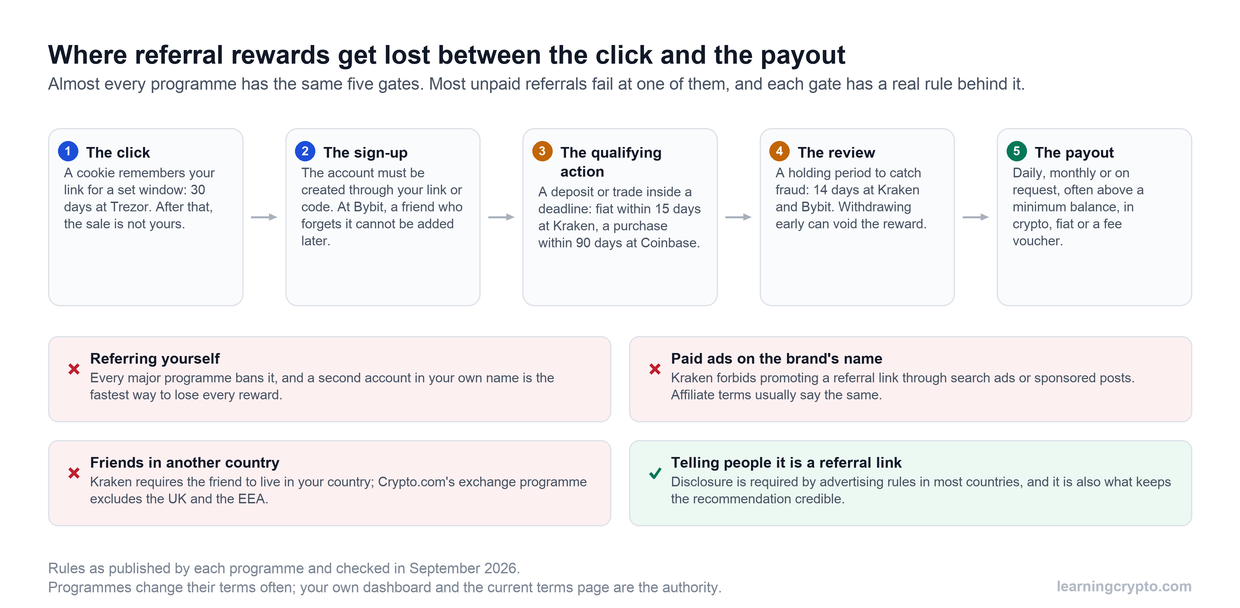
Most unpaid referrals fail at one of these gates rather than because the programme did not pay. Every rule shown comes from a named programme's published terms.
The fixes are unglamorous. Send people your link at the moment they are ready to sign up, not weeks before. Tell them the deadline and the minimum deposit. Never create a second account for yourself, which every major program bans and which can forfeit everything you have earned. Never buy ads on a platform's brand name unless its terms allow it. And if a friend lives in another country, check whether they qualify before you promise them a bonus.
How do you choose the right program?
Pick the program that matches what your audience already needs, then check the terms. The best-paying program you cannot recommend honestly will earn less than a modest one you can.
- Would you recommend it with no reward? If not, stop there.
- Is the platform safe? A referral program is a reason to scrutinise a platform, not a substitute for doing so. Our guide on checking whether a crypto platform is safe sets out the checks.
- Does the reward repeat, and for how long? Twelve months, a lifetime of renewals, and a single bonus are very different deals.
- Where is it available? Regional exclusions are common and change often.
- How and when does it pay? Cash, crypto, a fee voucher, and a minimum payout balance all affect what the money is worth to you.
Are crypto referral rewards taxable?
In most countries, yes. Referral bonuses and affiliate commissions are generally treated as income at their value when you receive them, and if you are paid in crypto that later changes in value, selling it can create a separate gain or loss. Fee vouchers and discounts are usually treated differently from cash, and rules vary by jurisdiction. Record the date, amount and value of every reward as it arrives, as described in our crypto record-keeping guide, and see our crypto tax guide for the wider picture. This is general information, not tax advice.
Which referral schemes should you avoid?
Anything where the main way to earn is recruiting other people. A program that pays you for your recruits' recruits, promises fixed daily returns, or requires you to buy in before you can refer is a pyramid scheme wearing crypto clothing, and those collapse. Legitimate programs pay you from a real product's revenue: trading fees, hardware sales or subscriptions.
Be wary too of websites that list referral codes promising bonuses far above what the platform itself advertises. Some are simply out of date. Others send people to cloned sign-up pages. Our guides to common crypto scams and fake support contacts cover the patterns. If you are promoting a platform, you share responsibility for where you send people, which is the best reason to promote only what you use.
More beginner guides are collected in our Fundamentals hub, and our list of crypto learning resources is a good next read for anyone building an audience around education.
Frequently asked questions
How do you earn crypto with referral links?
Copy your personal referral link from the platform's referral or invite section, share it with people who are about to sign up, and make sure they complete the qualifying step, usually a deposit or trade, before the deadline. The platform then credits a bonus or a share of their fees to your account. Affiliate programs work the same way but require an application first.
Which crypto referral program pays the most?
For casual referrals, Binance and Bybit advertise the largest headline rewards, but they depend on friends trading heavily. For creators, recurring programs pay the most over time: Learning Crypto pays 40% of the first payment and then 20% of every renewal, and CoinLedger pays 25% each year a customer renews. Recurring rewards usually beat one-off bonuses.
Are crypto referral rewards taxable?
Generally yes. Most tax authorities treat referral bonuses and affiliate commissions as income at their value when received, and selling crypto rewards later can create a separate gain or loss. Fee vouchers may be treated differently. Keep a record of each reward's date and value, and check the rules in your own country with a professional.
Can I use my own referral link?
No. Every major exchange and affiliate program bans self-referral, including opening a second account in your own name or a household member's to claim a bonus. Doing so can forfeit your rewards and get both accounts closed. Some programs also limit rewards to one per household or device.
Are there crypto referral bonuses with no deposit required?
Rarely. Almost every exchange requires the referred friend to deposit, buy or trade a minimum amount before any bonus is paid: Kraken requires a fiat deposit, Bybit a 100 USDT deposit and 500 USDT of trading, and Binance a $50 purchase and $100 trade. Affiliate programs pay when a purchase is made rather than on sign-up.
How does the Learning Crypto referral program work?
You apply on the partner program page and receive a personal link and dashboard. When someone subscribes through your link, you earn 40% of their first payment, up to $280, and then 20% of every renewal for as long as they stay subscribed. There is no limit on the number of members you can refer.
What is the difference between a referral and an affiliate program?
A referral program is open to any customer and pays a small reward for inviting friends, usually once. An affiliate or partner program is for people with an audience, requires an application, and pays a percentage of what referred customers spend, often on a recurring basis. Affiliates typically get a dashboard, tracking and marketing materials.
Keep learning
- What Is Hyperliquid? The Complete Beginner's Guide to the On-Chain Perps Exchange
- Trezor vs Ledger: Which Hardware Wallet Should You Choose?
- How to Tell If a Crypto Exchange or Wallet Is Safe
- Crypto Record Keeping: What to Track for Tax
- Join the Learning Crypto partner program
- More guides in the Fundamentals hub